Not all tax provisions are created equal. Especially when you’re a high-income W-2 earner trying to do something about a six-figure tax bill. The two main options are Real Estate Professional Status and the short-term rental exception. Both fall under Section 469 of the tax code and can make rental losses non-passive.
That’s where the similarities end. One effectively requires you to become a full-time real estate professional. The other doesn’t. Understand the difference before you spend time and money pursuing the wrong path.
How Section 469 Treats Rental Losses by Default
The Internal Revenue Code divides income and losses into two categories: passive and non-passive. Under Section 469, passive losses can only offset passive income. They can’t touch your salary, your bonus, or anything else the IRS considers non-passive. If you’re a high-earning W-2 professional, that typically means a huge yearly tax bill.
Section 469 defines two types of passive activity. The first is any business where you aren’t actively involved. The second is rental activity, regardless of how involved you are.
Unlike trades or businesses, rental activities are passive (at least according to Section 469). Even if a taxpayer manages every decision of their rental property, responds to every tenant issue, and logs hundreds of hours a year, the losses generated are still classified as passive.
For a physician, pilot, or corporate executive with a six-figure federal tax bill, this means rental property losses accumulate on their return without providing any relief against wages.
Eventually, those losses carry forward and can be used against passive income, or when you sell the property. But in the current year, against the income creating the tax problem, they do nothing.
You can get out from under that default by meeting one of two narrow exceptions the code allows.
Real Estate Professional Status
The first way out of the passive default is qualifying as a real estate professional (commonly called REPS). According to Section 469(c)(7), if you qualify, your rental losses can be treated as non-passive, which means they can reduce your W-2 income.
To qualify, you have to meet two conditions at the same time. You must:
- Spend more than 750 hours a year in real estate trades or businesses where you’re actively involved.
- Spend more than 50% of all your working hours on real estate.
That second condition is what makes REPS nearly impossible for most W-2 earners. If you’re a pilot logging 900 flight hours a year, a physician working over 50 hours a week, or an executive with a 2,400-hour work year, there’s no way to make real estate your full-time commitment. The numbers don’t add up.
REPS was designed for people whose livelihood already comes from real estate. People like brokers, developers, asset managers, and property managers who naturally spend the majority of their working hours in the field.
It can also apply to someone who has retired from their primary career and has shifted fully into real estate. But if you’re that pilot still flying, physician still practicing, or executive still employed, REPS isn’t a realistic option.
The STR Exception
The short-term rental exception works completely differently from REPS and is a much more approachable way for high earners to reduce W-2 taxes.
It doesn’t require you to spend most of your time as a real estate professional. Instead, it comes down to what kind of property you own and how you are involved in running it.
Under Section 469, a property rented out for seven or fewer days isn’t classified as a rental property at all. It’s treated as a business.
Remember, rental activity is always treated as passive, no matter how involved you are. Business activities are only passive if you aren’t involved. Once your property is classified as a business rather than a rental, your level of participation suddenly makes a huge difference.
When you meet the material participation standard for a qualifying short-term rental, the activity is non-passive, meaning the losses it generates flow directly against your W-2 income.
The material participation standard means you need to spend more than 100 hours of documented involvement on the property during the first year, and more hours than any single other person involved.
Many professionals can meet this standard while managing demanding careers. The heavy level of participation is only required in the first year, and those few extra hours a week can save you a lot once that year’s tax season hits.
When you use the STR exception, you don’t need to change careers to become a real estate professional. You need genuine, documented participation in one qualifying property.
How to Make the STR Exception Work as a Busy W-2 Earner
Even though 100 hours is much more manageable than 750, it can still be confusing to know what activities qualify. A done-for-you strategy can help. You don’t have to do everything. If you work with an operating partner, they can handle:
- Build-out
- Booking management
- Daily operations
You focus only on the activities that will help you meet the material participation standard. Things like:
- Design input
- Guest content
- Inspections
- Market research
For the busy W-2 earner facing a huge tax bill, the STR exception can be a great solution. REPS was written for a different taxpayer entirely.
Which Strategy Is Right for You?
Most high-income earners assume the tax code offers little beyond the typical 401(k), and the options available seem insignificant compared to a six-figure tax bill. A short-term rental exception can help.
This strategy isn’t a tax loophole for W-2 employees. It’s built on tax code that designates short-term rentals as a business.
REPS asks you to restructure your entire professional life. The STR exception asks you to participate for 100 hours in the first year. If you’re still employed in your primary career, REPS isn’t the right path. The STR exception is the provision written for exactly where you are.
Success happens when the property qualifies, the participation is real and documented, and the right professionals are involved from the beginning. A CPA familiar with Section 469 and an operating partner who has executed this structure before can make a big difference in how much extra work and stress you take on.
Video
Infographic
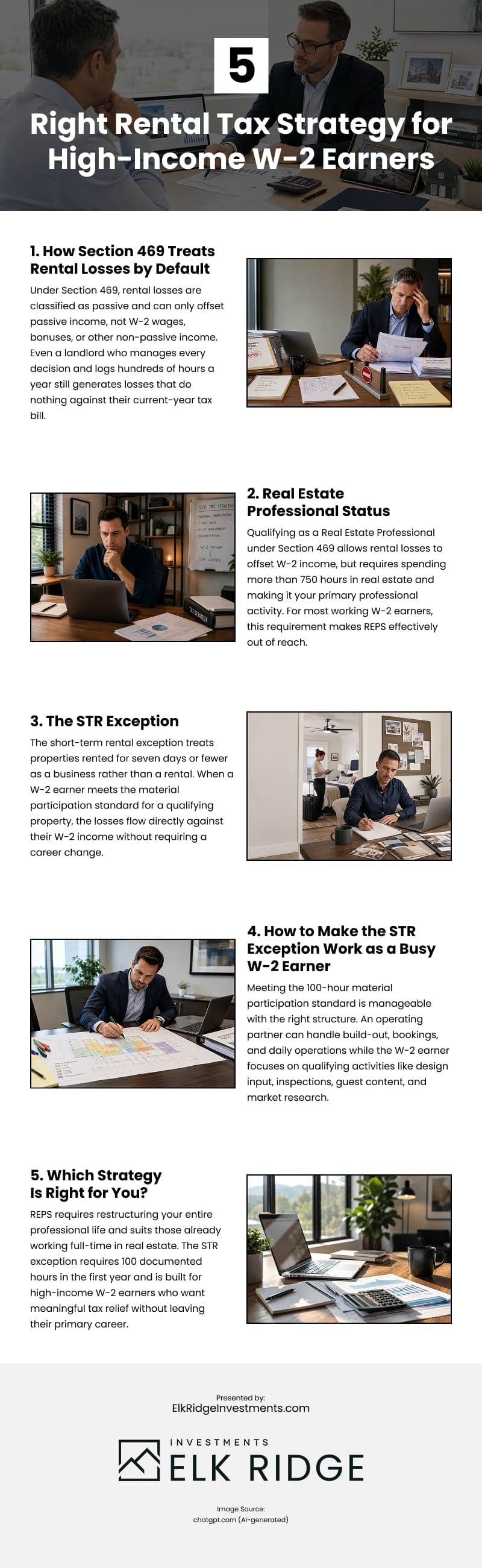
High-income W-2 earners face a built-in tax disadvantage under Section 469, but two narrow exceptions offer real relief, and knowing which one fits your situation can make a significant difference. Discover rental tax strategies for high-income W-2 earners in this infographic.