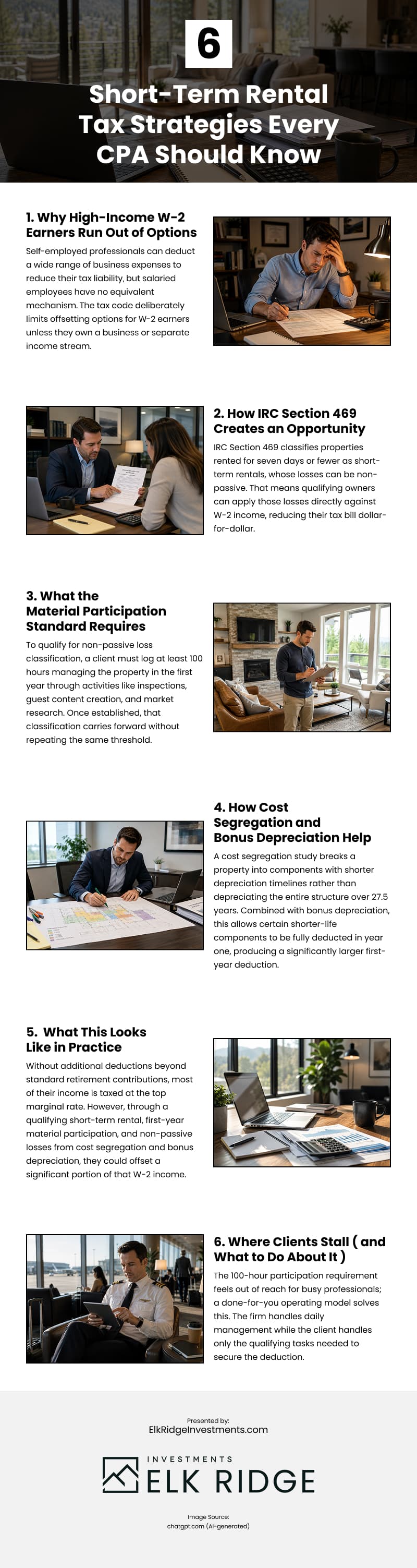
Your high-income W-2 clients are probably paying too much in taxes. Not because you’re missing something obvious, but because most legitimate deductions simply don’t apply to wage earners the way they apply to those who are self-employed.
A well-structured short-term rental tax strategy can help salaried clients mitigate their tax burden. This code-backed approach results in substantial non-passive losses that offset W-2 income. Here’s how it works and what your clients need to do to qualify.
Why High Income W-2 Earners Run Out of Options
Self-employed and 1099 professionals can deduct a long list of expenses before calculating their tax liability. Things like a home office, car, equipment, and health insurance all help them offset what they owe. A salaried employee earning the same gross income doesn’t have that option, and often ends up paying much more in taxes.
The typical advice to max out a 401(k) can provide some relief, but the limits are modest. If your client is a doctor making $400,000 annually and writing a $100,000 check to the IRS every April, that little bit of relief barely makes a dent.
The tax code was deliberately structured this way, providing limited offsetting mechanisms for W-2 earners taxed on gross wages. Unless they own a business or have separate income streams, the options for reducing taxes are narrow.
How IRC Section 469 Creates an Opportunity
The key that makes short-term rentals useful for W-2 earners comes from Internal Revenue Code (IRC) Section 469. Under this section, the definition of short-term rentals applies to properties rented for seven or fewer days. These are treated differently from long-term rental properties.
While long-term rentals do generate depreciation losses, those losses are considered passive. Generally, passive losses can only be used to offset passive income, something that doesn’t help most W-2 earners when the tax bill hits.
Short-term rentals work differently. When an owner meets the material participation standard for a short-term rental, the resulting losses become non-passive. The owner can apply those non-passive losses directly against W-2 income, reducing taxable income dollar-for-dollar in the year they’re generated. Ultimately, that can mean much lower taxes for your client.
According to the IRC, the property doesn’t determine the tax classification; the rental period does. Two identical properties in the same market can yield completely different tax outcomes depending on how long it’s rented. Only short-term rentals qualify to reduce taxable W-2 income.
What the Material Participation Standard Requires
To qualify for the non-passive classification, your client must actively participate in managing the property. That means a minimum of 100 hours in the first year, and more hours spent that first year managing than any other person involved with the property.
A client can accumulate these hours when they:
- Contribute to property design decisions
- Build guest digital content, such as local area guides and itineraries
- Conduct in-person inspections
- Review market comparables
The first year is the critical window. Once your client establishes the non-passive loss, they don’t need to meet the same participation standard going forward. That non-passive classification remains. Many clients repeat this annually with new properties, and let the benefits compound.
How Cost Segregation and Bonus Depreciation Help
The deduction itself comes from a cost segregation study. This formal, engineering-based analysis breaks a property into components with shorter depreciation timelines. Rather than depreciating the entire structure over 27.5 years as a residential property, cost segregation separates components such as flooring, cabinetry, lighting, and landscaping into 5-year, 7-year, and 15-year categories.
Bonus depreciation lets your client deduct certain shorter-life components all in year one. When combined, cost segregation and bonus depreciation offer a much larger deduction in the first year, rather than a small deduction over decades.
What This Looks Like in Practice
Take a pilot earning roughly $700,000 annually. Without additional deductions beyond standard retirement contributions, most of their income is taxed at the top marginal rate.
Through a qualifying short-term rental, the pilot can meet the material participation standard in the first year, and the estimated non-passive losses generated by cost segregation and bonus depreciation could offset a meaningful portion of that W-2 income.
In addition to the tax benefit, the property generates rental income. Short-term rental properties in strong markets can yield profits that are taxed differently from W-2 wages. Once your client has claimed the first-year depreciation, they still hold an income-producing asset with operations already up and running.
Your client isn’t buying real estate as much as they are acquiring a tax strategy, a paper loss. The property still holds value and generates annual rental revenue, while also offsetting earned income in that first year.
Where Clients Stall (and What to Do About It)
The participation requirement is what drives most clients away. They understand the strategy, but logging 100-plus hours in the first year on a property they don’t live in day to day feels unrealistic, especially for professionals with demanding schedules.
A done-for-you operating model solves this problem. When your client co-owns a property with an operating firm that handles acquisition, buildout, and daily management, the firm takes on the burden of daily operations, leaving your client able to focus only on qualifying tasks.
For CPAs who want to bring this type of strategy to their high-income W-2 clients, Elk Ridge Investments structures joint-venture short-term rentals built around this exact model. We source, acquire, and operate the properties. Capital partners participate enough to qualify for the deduction in the first year and earn rental income going forward. It’s a practical path to a strategy most clients couldn’t execute on their own.
Video
Infographic
A well-structured short-term rental tax strategy enables salaried clients to significantly reduce their tax burden, especially for high-income W-2 earners who lack the expense deductions available to self-employed individuals. Explore six short-term rental tax strategies every CPA should know in this infographic.